
Searching for Seashells
Discovering Daily Bread

My partner and I try to live sparingly. We don’t make much and for the majority of our marriage one of us has been in school. She is a teacher and teachers are criminally underpaid in this country. Even so, she has always been the “breadwinner” and it makes sense considering I’m a failed musician and academic turned pastor.
Though I’ve never made a great deal of money, I’ve always found a way to make enough while working within the bounds of my discipline. There was never a point when I thought what I had wouldn’t be enough. After all, I am my father’s son, and I’m damn good with a budget. I look back at those first few years and wonder how we made it… and then I remember rent for a one-bedroom apartment was $750 a month and my wife and I paid a meager $600 a month for the first house we lived in together. We were in the south and that first house was rough… but it was enough.
I think it was enough because I knew I’d one day have a university professorship. The promise of a comfortable, secure life with meaningful work and a charming home, papered over what we didn’t have. It was as if life itself had been filtered through rose colored glasses. Challenges, whether great or small, personal or professional, financial or relational, were all filtered through the promise of a sure and secure future.
The rose color began to fade when we moved to New England. I had accepted an incredibly generous offer to pursue a Master of Divinity at the Boston University School of Theology though I soon learned why the offer I received had been so generous… finding an affordable residence within a reasonable distance to both Abbey’s school and Boston University proved almost impossible. We are where we are now only because one of my wife’s colleagues called us one day and just offered us a place to rent. It was a miracle.
Every season has had its challenges but this one has been the most challenging for me personally. I left home. I left behind a secure network of friends, colleagues, and family. My aptitudes are fine-tuned to the southern United States and not New England. There’s no denying the rising tide of authoritarian fascism in this country and the implications of autocracy upon everyone—citizen and foreigner, rich and poor, Christian or not. And then there’s the collapse of liberal arts education and the subsequent realization that all of the jobs I was training for would no longer exist by the time I would be qualified to apply for them. Oh and the rapid closure of Christian churches that had been cultivated years earlier by the shallow sowing of seeds that temporarily filled pews, built large buildings, and made fine music, but did not in any way resemble the fruit of the Spirit.
That and to live in this country, even simply, is no longer a sustainable, viable proposition. The rich are richer than ever before. Power and privilege are wielded to benefit and protect the few at the expense of all others. We are living in an era of unprecedented economic inequality. The gap between the rich and the poor in this country has been widening since the 1980’s and according to the Economic Policy Institute, the top 1% take home 21% of all income in the United States. For the first time in American history, the top 10% account for half of all consumer spending while the majority of Americans have just stopped buying things because the can’t afford basic necessities. 61% of Americans live paycheck-to-paycheck and 47% doubt their ability to find a good job.
The rose colored glasses no longer work. Without the promise of sure and prosperous future, without the assurance that what we have is enough, without a viable career path, without the comforts of home and the safety of secure attachments, without confidence in our democratic systems and the rule of law, and without the assurance the church can actually do good in the world or that God actually has our best interest at heart… what will sustain us?
Are we just on our own?
It wasn’t long after Abbey and I began dating that I first visited Pawleys Island, South Carolina. She and her family had vacationed here for years, long before she met me.
Although Abbey and I manage a tight budget, we’re privileged to live in proximity to wealth. We have family and friends we can call upon for help if we ever needed it, and we get to do things like vacation together to the beach.
That first trip to Pawleys Island I remember Abbey bending down and combing through seashells looking for what she called a “Pawleys Island shell,” also known as, an Imperial Venus Clam. I had never seen a seashell like it.


I soon learned they were quite popular in these parts. They can be found in all of the local gift shops adorning all sorts of keepsakes and souvenirs. Artists paint them. Jewelers make jewelry out of them. They’re quite rare and only found here in lowcountry of South Carolina.
Unfortunately, in recent years, they’ve become harder to find. The first year I visited Pawleys Island with Abbey, she’d return from a walk on the beach with a handful of shells, but now, we find maybe five to ten over the course of a week. Beach erosion and the artificial replenishment of sand have made these treasures more elusive.
Every year, Abbey and I walk the beach and search for shells. I remember one year I hadn’t found a single shell the entire week. I hate to admit this but I begged that God would just let me find one shell… as if I were begging for a miracle. Surrounded by beauty on all sides, in a place where I had been moved to awe and wonder time and time again, I found myself staring at the ground, coveting a seashell…
Occasionally, I’d get my miracle and find a Pawleys Island shell. I think it’s funny that the shells I find never quite look like what I had imagined they would. I usually picture myself finding one of the small, stereotypical Pawleys Island shells (pictured above on the right) but this year, we found a bunch of broken ones and a particularly exceptional one. It was larger than a typical Pawleys Island shell and it appeared almost translucent in amidst the other shells.
As I combed through the sand earlier this week, I felt tempted once again to pray for a miracle… to forsake all else to find a seashell…
But this time, I held that thought captive. It’s a stupid thought—I know—but it was real nonetheless. I let it work on me. What if I didn’t get my miracle? What if I didn’t find a Pawleys Island shell? Or worse, what if they were really all gone, buried beneath the sand or swept away by the changing climate?
What if I never become a professor?
What if these new roots don’t take hold in New England?
What if I can’t find meaningful work that sustains us, nourishes me, and contributes to the flourishing of others?
What if the great American democratic experiment has failed and we’re subject to the rule of white supremacists, Christians Nationalists, and ethnofacist imperialists?
What if there isn’t enough and this is our Great Depression and we really are just on our own… every man for themselves?
What if I’ve wasted my life on message defined not by the love and grace of God but by the vengeance and power of those who claim God?
What if there is no miracle?
Until now, I’ve never really understood why preachers use movies as sermon illustrations. Admittedly, I am taken by the idea that truth is not bound by any particular religious tradition and can be revealed by art in all its forms but referencing a movie to make a point in a sermon is just really hard to do. There’s a reason why they say “a picture can paint a thousand words.” In a sermon, you have to do with words what a movie does with the power of visual storytelling…
And now I will attempt to do just that… In Wake Up Dead Man, Rian Johnson’s latest installment of Netflix’s Knives Out series, Father Jud Duplenticy, a young, green priest, played by Josh O’Connor, is sent to help shepherd a small parish with a dark and troubled past. The parish’s priest, Monsignor Jefferson Wicks, played by Josh Brolin, is a terribly territorial and angry man who believes it his duty to defend the church from “feminist, Marxist whores” and restore it to its rightful place as the moral authority over culture and society. After Monsignor Wicks is murdered in his own parish, the local police chief, Geraldine Scott, played by Mila Kunis, calls the infamous detective Benoit Blanc, played by Daniel Craig, to assist the investigation.
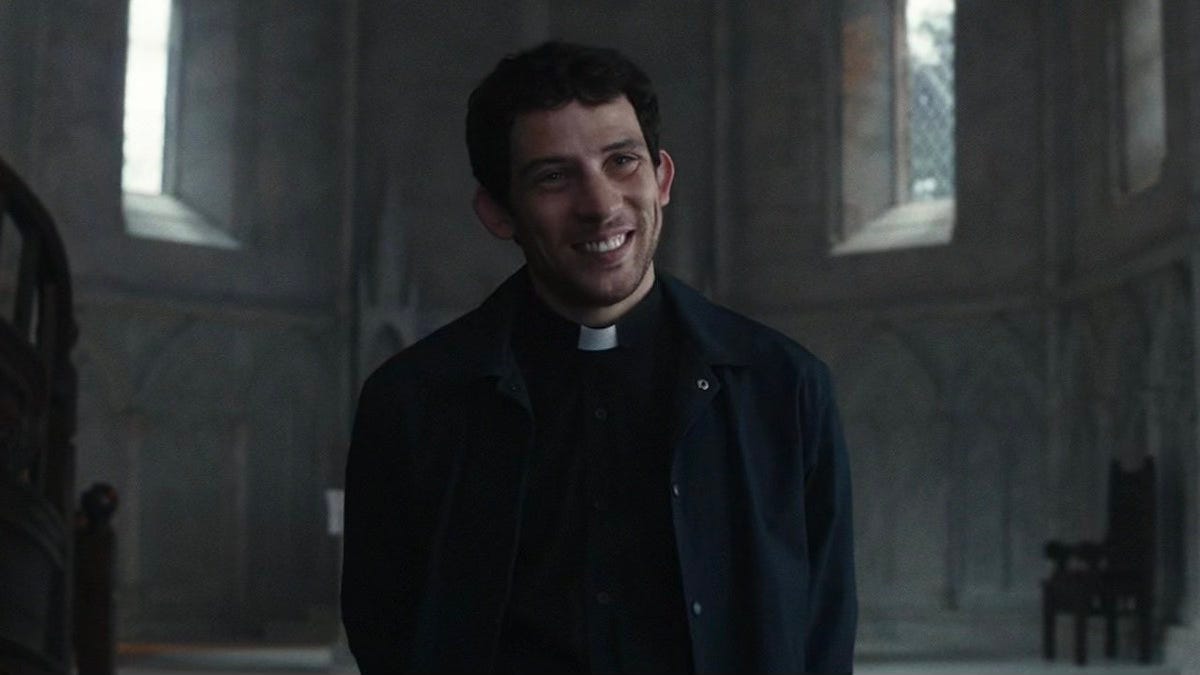
Like all of us, the parishioners of this afflicted community each find themselves in need of their own miracle. Toward the end of the film, Father Jud, describes what happened to each of the parishioners after the investigation, saying, "Some got their miracle. Not by being cured or fixed, but finding the sustaining power to wake up every day and do what we're here to do in spite of the pain. Daily bread."
I went searching for seashells and discovered daily bread. I got my miracle. Yes, I found that treasured Pawleys Island shell, but the miracle was wrestling with that thought and realizing that even if I hadn’t, being next to my wife, surrounded by beauty on all sides, held by the roar of the ocean, covered by the warmth of the sun, examining the wonder of creation, was enough.


I could pray for a miracle. And I still might. I could pray for a job that I feel like I’m good at, that nurtures life, and instills in me a sense of meaning and purpose. I could pray for new relationships and a newfound sense of rootedness. I could pray for financial sustainability. I could pray like Mary that the mighty be cast down and the rich be sent away. I could pray for the church and that he would examine his ways and come home…
And even if none of it comes to pass, may my sustenance come not from promises that were never promised but from the one who is our daily bread. The one who is present with us now in this moment. The one to whom less than enough is more than enough. The one who made miracles happen. Lest I forget the miracles that have already happened—like finding a place to live and repeatedly being offered jobs tailor made for specific seasons in my life. May we be sustained by one who gives us what we need today and assures us that we need not worry about tomorrow.